
This article was written in January 2013 by Ross Davies and originally published on the Siamese Cat Breeder website.
PRA in Siamese cats is a topic I have written about briefly before. After publishing the first article I was contacted by people in the UK who have Siamese cats affected by PRA. For this reason I decided to write another article with further information and also some suggested guidelines on responsible breeding. Please read on to see how breeding cats that are PRA positive can easily be avoided by DNA testing and selective breeding.
For clarity – PRA is equally an issue for Siamese, Orientals, Balinese and Oriental Longhairs.
What is PRA
Progressive Retinal Atrophy or PRA as it usually referred to is a disease of the retina which ultimately causes blindness. The disease is known to be present in Abyssinians, Somali and has been widely reported to be present in Siamese and Oriental cats.
The retina contains cells called photoreceptors which absorb the light focused on them by the eye lenses and converts them into electric signals which are passed through the optic nerve to the brain. The brain interprets these signals where they are perceived as vision. When a cat has PRA the photoreceptors degenerate over time and ultimately cause blindness. Typically the sight in affected cats gradually gets worse with total blindness around 4 to 5 years, though there are reports of total blindness not being diagnosed until much later.
Ophthalmoscopic Testing for PRA
Testing a cat suffering from progressive retinal atrophy can be conducted by your vet where eye drops are administered to make the pupils dilate to enable observations and diagnosis of the disease.
DNA Testing for PRA
Importantly there is now a DNA test for the rdAc mutation which is thought to be the most common cause of PRA. The presence of both sets of the recessive gene, indicate the cat will suffer from progressive retinal atrophy and ultimately blindness.
Is PRA in Siamese Cats Something New?
No PRA is not something new, what is new is an increased awareness and availability of DNA testing. People will probably think Siamese and Oriental cats never went blind in the past so what has changed?
Well maybe this is true or perhaps the cats that were PRA positive gradually did go blind. Due the gradual nature of the progression of the disease perhaps these cats adapted relying more so on their other senses.
It seems possible that PRA has not been diagnosed because the cats have not shown symptoms until they are older. Vets may have dismissed it as age related deterioration.
Could it be that blindness has been noticed and not reported to breeders? Or worse it has been reported and ignored?
I could offer a variety of other theories; but that is exactly what they would be – theories.
The responsible thing to do at this stage is to start to collate some real data. To gather this data we must start by DNA testing our cats. Gathering data on the PRA status of cats and also data on how many cats are actually going blind (or indeed not going blind) are both essential to enable informed choices regarding potential registration policy changes.
On a personal note I must admit I am not totally convinced that we have a massive problem at this stage. What I am sure about though is without more research we will never know if we have a problem. As thing stand today I am not in favour of any registration policy changes – we do not have enough evidence one way or the other!
There have been cats diagnosed with PRA in this country. The cats in question tested positive for two sets of the rdAc mutated gene which is the gene thought to cause progressive retinal atrophy.
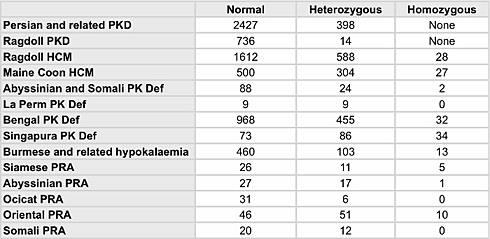
Below is a screen shot of the results for various gene tests performed at Langford (UK) which include the Siamese and Oriental cats tested for PRA and their results. Although the results are interesting, at this stage it would be very unwise to make any conclusions based on this data. There is simply not enough information to make any decisions with one exception. We need to test more cats!
 Possible Recommendations
It would seem more than sensible to utilise the available DNA test for PRA.
Testing our cats will help us understand the extent of the spread of the gene.
It will also help prove or disprove the theory that all PRA positive cats will eventually be totally blind.
By knowing the PRA status of our cats we can selectively breed away from this gene and prevent any chance of cats being born PRA positive.
Testing is available at:
Langford Veterinary Services (UK)
UC Davis Veterinary Medicine (USA)
Responsible Breeding and PRA
Because the gene has to be present twice to cause blindness, and because we can test for it, we can breed cats that have zero chance of being affected. The table below shows what each type of mating produces — the golden rule is simply that a carrier or an affected cat should only ever be mated to a DNA-clear cat.
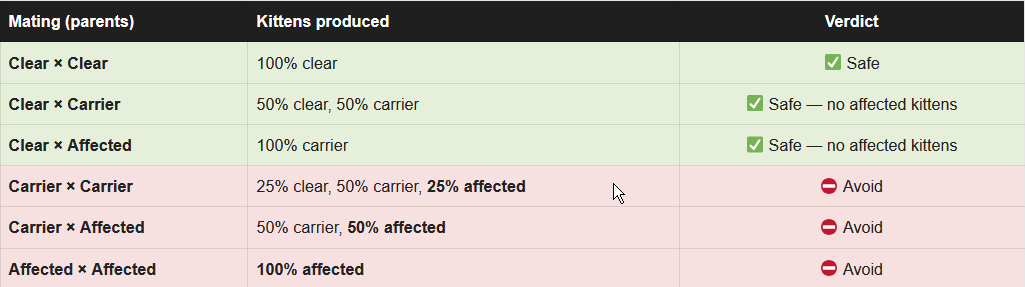
How the rdAc gene passes down each type of mating. “Affected” cats will go blind; “carriers” never do but can pass the gene on.
My suggested guidelines follow straight from that table:
Only breed from cats whose rdAc status is known.
Carriers should only be mated to clear (negative) cats.
Positive cats (two copies) should only be mated to clear cats — never to another carrier or positive.
Follow those and no kitten you breed will ever be affected by rdAc PRA. It could be argued that positive cats shouldn’t be bred from at all — and that’s a fair position — but a positive mated to a clear cat produces only carriers, never affected kittens. The danger of trying to purge the gene too aggressively is that you slam the gene pool shut and lose valuable genetic diversity. Until we know how widespread the gene really is, careful selective breeding beats blanket exclusion.
If you’d like to understand the genetics behind this and your cats’ colours, my Siamese colour predictor and genetics article are good companions to this one, and I set the whole topic of health testing in context in my complete guide to breeding Siamese cats.
How Else Can You Help?
Raising awareness of this potential problem is the only way to move forward in understanding and potentially tackling PRA head on. If you have a breeders website or if your cat club has a website please link to this article and help raise awareness about PRA.
Please refer to the chart below that illustrates really how easy it would be to breed away from PRA without compromising the genetic diversity of the Siamese and Oriental gene pools. Or at the very least breed cats that have no chance of inheriting two rdAc mutated genes.
Please feel free to re-publish the infographic below.